Bitcoin’s 2026 Market Structure Reveals A Problem Hidden Beneath ETF Growth
Bitcoin has lost the $80,000 level as selling pressure and market uncertainty combine to test the resilience of a recovery that had been building since the April lows. The breakdown is significant, and XWIN Research Japan has published a structural analysis that places the current weakness in a context that goes considerably deeper than a technical support level failing to hold.
The analysis begins with a premise that reframes how the entire 2026 Bitcoin market should be understood. This cycle is structurally different from the ones that preceded it. ETFs, corporate treasury allocations, interest rate dynamics, regulatory development, and dollar liquidity conditions now influence Bitcoin’s price behavior in ways that did not exist during the 2020 to 2021 advance. The asset has institutionalized — but the on-chain data tells a more complicated story about what is actually driving day-to-day price movements.
The Coinbase Premium Index is where the structural concern becomes most visible. The metric measures the price gap between Coinbase — the primary venue for US institutional spot buying — and offshore exchanges like Binance. During the 2020 to 2021 bull market, that premium stayed predominantly positive, reflecting sustained American institutional demand flowing into the spot market through the most regulated and most scrutinized venue available.
In 2026, that premium has repeatedly fallen into negative territory — a reading that XWIN Research Japan identifies as the gap between the narrative of institutional adoption and the reality of where actual spot demand currently stands.
Two Realities And The Question That Defines What Comes Next
The XWIN Research Japan analysis holds two contradictory truths simultaneously and refuses to resolve them prematurely.
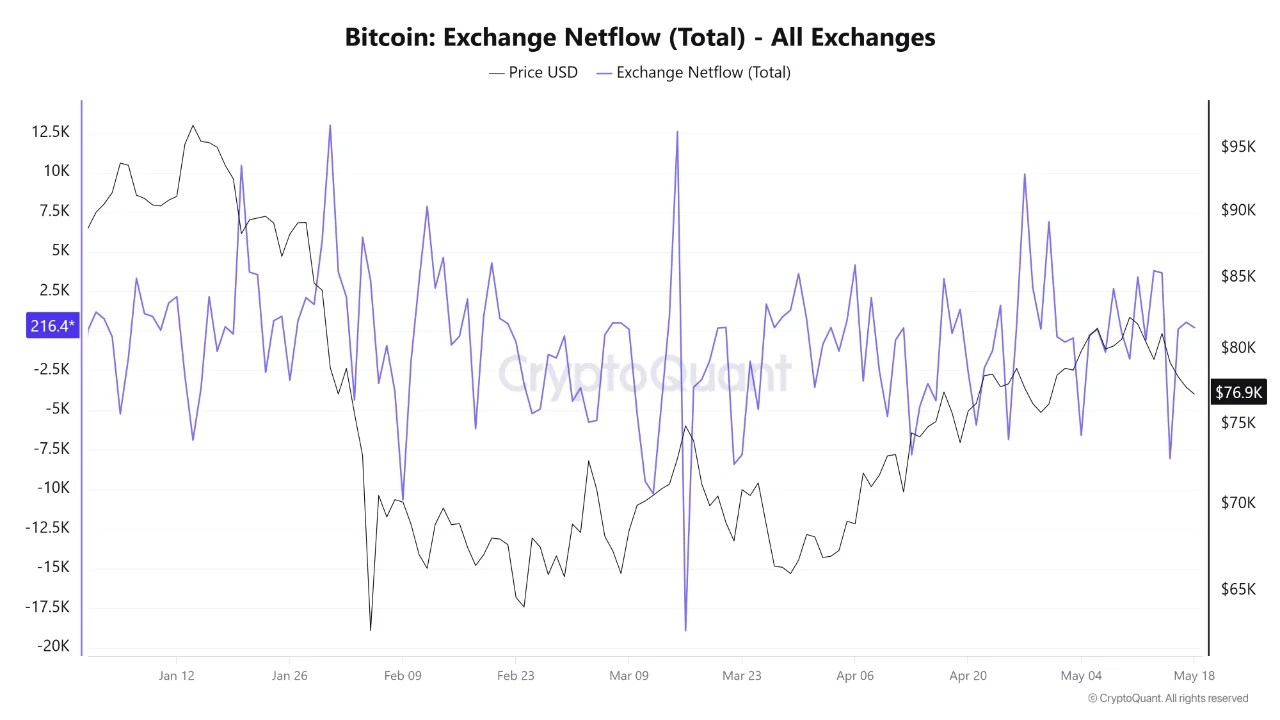
The long-term picture remains structurally constructive. Exchange reserves have declined to approximately 2.68 million BTC — coins leaving exchanges and moving into long-term holding, ETF custody, and low-liquidity storage at a sustained pace. Less Bitcoin available on exchanges means less immediate sell-side supply, and the directional trend of that reduction supports the supply squeeze argument that underpins the long-term bullish case.

The short-term picture tells a different story. Open Interest has surged since April 2026 while funding rates remain unstable — the signature of a market where leverage-driven futures activity is dominating price discovery rather than genuine spot accumulation. Recent price movements, including the recovery from the April lows and the current breakdown below $80,000, reflect derivatives positioning more than the organic spot demand that characterized Bitcoin’s most durable advances.
The Exchange Stablecoin Ratio adds the missing piece. The decline in stablecoin waiting capital — the dry powder sitting on exchanges ready to deploy into spot purchases — confirms that the aggressive USDT and USDC inflows that fueled the 2021 advance have not returned at a comparable scale.
The question XWIN Research Japan identifies as the defining one for this cycle follows directly from those three signals. Bitcoin has built the institutional infrastructure — ETFs, corporate treasuries, regulatory frameworks — that the previous cycle lacked entirely. What has not yet been built is the sustained spot demand that converts institutional infrastructure into a durable bull market. Whether that demand arrives, and when, is what the next phase of price action will begin to answer.
Bitcoin Tests Critical Support As Recovery Momentum Continues To Fade
Bitcoin is trading near $76,900 after extending its rejection from the $81,000-$82,000 resistance zone, a region that continues to cap every recovery attempt since April. The daily chart shows BTC now slipping back below the 100-day moving average while remaining firmly trapped beneath the descending 200-day moving average, reinforcing the broader bearish structure still dominating the market.

The recovery from the February capitulation low near $63,000 initially showed constructive momentum, with Bitcoin reclaiming the $74,000 support region and printing a sequence of higher highs through April and early May. However, bullish momentum weakened significantly once the price approached long-term resistance, where repeated failed breakouts created a lower-high formation near local tops.
Importantly, Bitcoin is now approaching the highlighted demand zone between $72,000 and $74,000, an area that previously acted as the foundation for the broader rebound. Holding this region could allow BTC to stabilize and attempt another recovery phase. However, a decisive breakdown below support would likely expose the market to a deeper retracement toward the broader accumulation range near $64,000-$65,000.
Volume during the latest decline remains elevated relative to recent consolidation phases, suggesting active selling pressure continues driving price action. Combined with weakening Coinbase Premium readings and unstable futures positioning, the chart reflects a market still struggling to transition into a sustainable spot-driven bullish trend.
Featured image from ChatGPT, chart from TradingView.com