Bitcoin Supply In Profit Stalls At 71%: Still Not Enough For A Sustainable Recovery
Bitcoin is facing a critical test as volatility returns and price action remains unstable around the $90,000 level. Bulls are attempting to defend this psychological zone after recent turbulence, but confidence across the market is still fragile. With uncertainty dominating short-term sentiment, many traders are treating every bounce as a potential trap rather than the start of a confirmed recovery.
According to top analyst Darkfost, the market is still missing a key ingredient for a sustainable bullish continuation: a broad base of investors sitting in profit. He argues that despite Bitcoin’s resilience, there are not yet enough participants in positive territory to build the kind of structural comfort that fuels long-lasting uptrends.
This matters because latent profits are not inherently bearish. In healthy conditions, when most holders are in profit, the market tends to stabilize. Investors feel less pressure to sell, panic fades, and holding becomes easier. That environment often supports stronger trend development and reduces the risk of sharp downside reactions.
Still, Darkfost warns that profit dynamics only help up to a point. When unrealized gains become extreme across the entire market, they can eventually turn into overhead supply, triggering corrective phases.
Bitcoin’s Profit Structure Still Isn’t Bullish Enough
Profit distribution across holders can become a double-edged sword for Bitcoin. When the supply in profit climbs above 95% and approaches 100%, unrealized gains stop being supportive and begin turning into overhead pressure. At those extremes, investors have little incentive to hold through volatility, and even small shocks can trigger profit-taking that fuels corrective phases.
From a structural perspective, Darkfost argues the market needs to reclaim the 75% supply-in-profit threshold to rebuild a healthier foundation. Historically, Bitcoin has tended to sustain bullish conditions when this metric holds above that level, as most participants remain comfortable and less reactive to downside volatility.

Right now, however, the market sits near 71%, after dropping as low as 64%. Darkfost notes that readings this low have often appeared near the early stages of bear markets, even when the headline drawdown looks relatively contained. In this case, the decline of roughly 31% was enough to push a large portion of recent buyers underwater, suggesting many entered late in the move.
The recent rebound briefly lifted supply in profit back to 75%, but it failed to hold. That rejection likely reflects investors using the bounce to exit at breakeven or reduce losses. Going forward, reclaiming 75%–80% would signal stabilization, while further weakness could amplify panic-driven selling.
Volatility Keeps Bulls on the Defensive
Bitcoin is attempting to stabilize near the $90,000 mark after a volatile correction that reshaped the market structure over the past few months. The chart shows BTC printing a major peak around $125,000 before rolling over into a sharp selloff. Accelerating into November and eventually finding a local floor near the mid-$80,000s. That drop marked a decisive break in momentum and triggered a shift toward a lower range, where price has struggled to regain prior support levels.
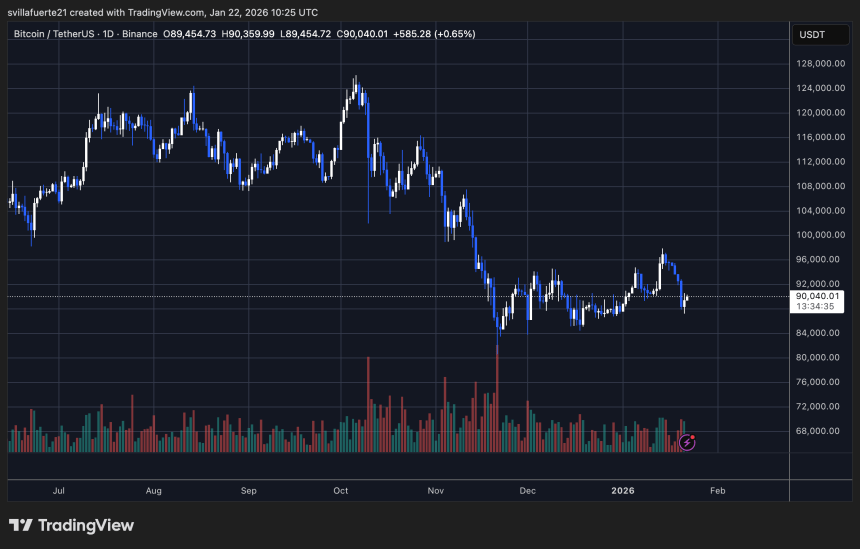
Since the rebound off the lows, Bitcoin has moved into a consolidation phase, repeatedly testing resistance around $92,000–$95,000 but failing to generate sustained continuation. Each recovery attempt has been met with selling pressure, suggesting that short-term supply is still active near former breakdown zones. The latest bounce back toward $90,000 signals buyers are defending the level. But the structure still looks fragile without a clean breakout.
Volume also reflects uncertainty, with higher activity during selloffs and more muted participation during rebounds. Bulls likely need to hold $88,000–$90,000 and reclaim the $92,000 region with conviction.
Featured image from ChatGPT, chart from TradingView.com


