The 10 Best Crypto Cards for Debit and Credit Spending in 2026
The crypto cards are payment cards that let you spend cryptocurrencies like Bitcoin, Ethereum, or stablecoins at regular stores by converting them into fiat in real time. They mainly come in debit, prepaid, and credit types, and they offer features like instant crypto-to-fiat settlement, cashback rewards in crypto, and global Visa or Mastercard acceptance.
The best crypto cards are MetaMask Card, Crypto.com Visa Card, Gemini Credit Card, Nexo Card, Bybit Card, Wirex Card, Bleap Crypto Card, Oobit Crypto Card, Brex Credit Card, and Bitget Visa Card.
In this guide, we will review 10 of the best crypto cards available right now based on their features, fees, rewards, and infrastructure. We will also explain how to evaluate crypto card attributes, break down how crypto cards actually work, and help you understand which type of card fits your everyday or business spending needs.
1. MetaMask Card
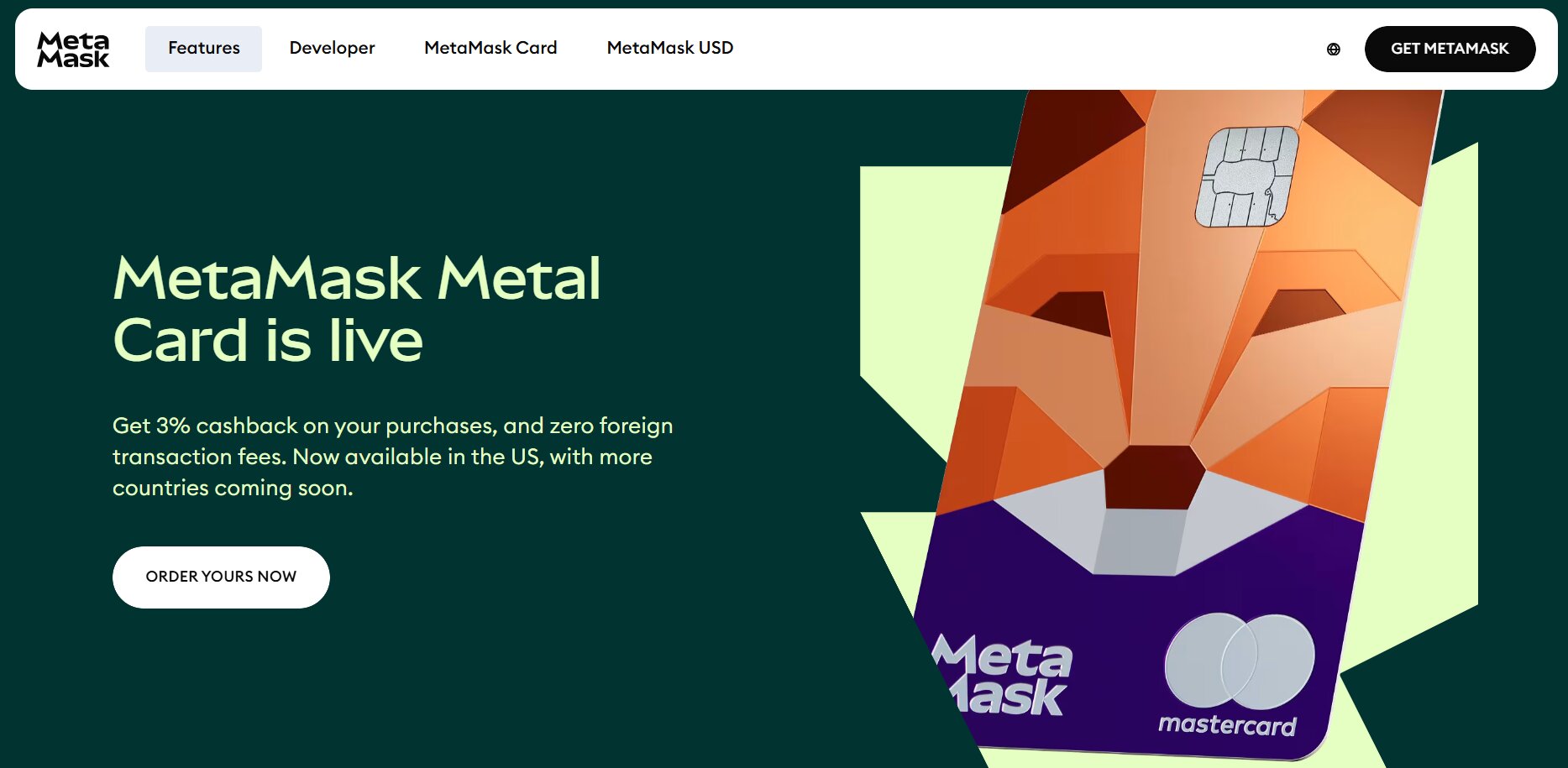
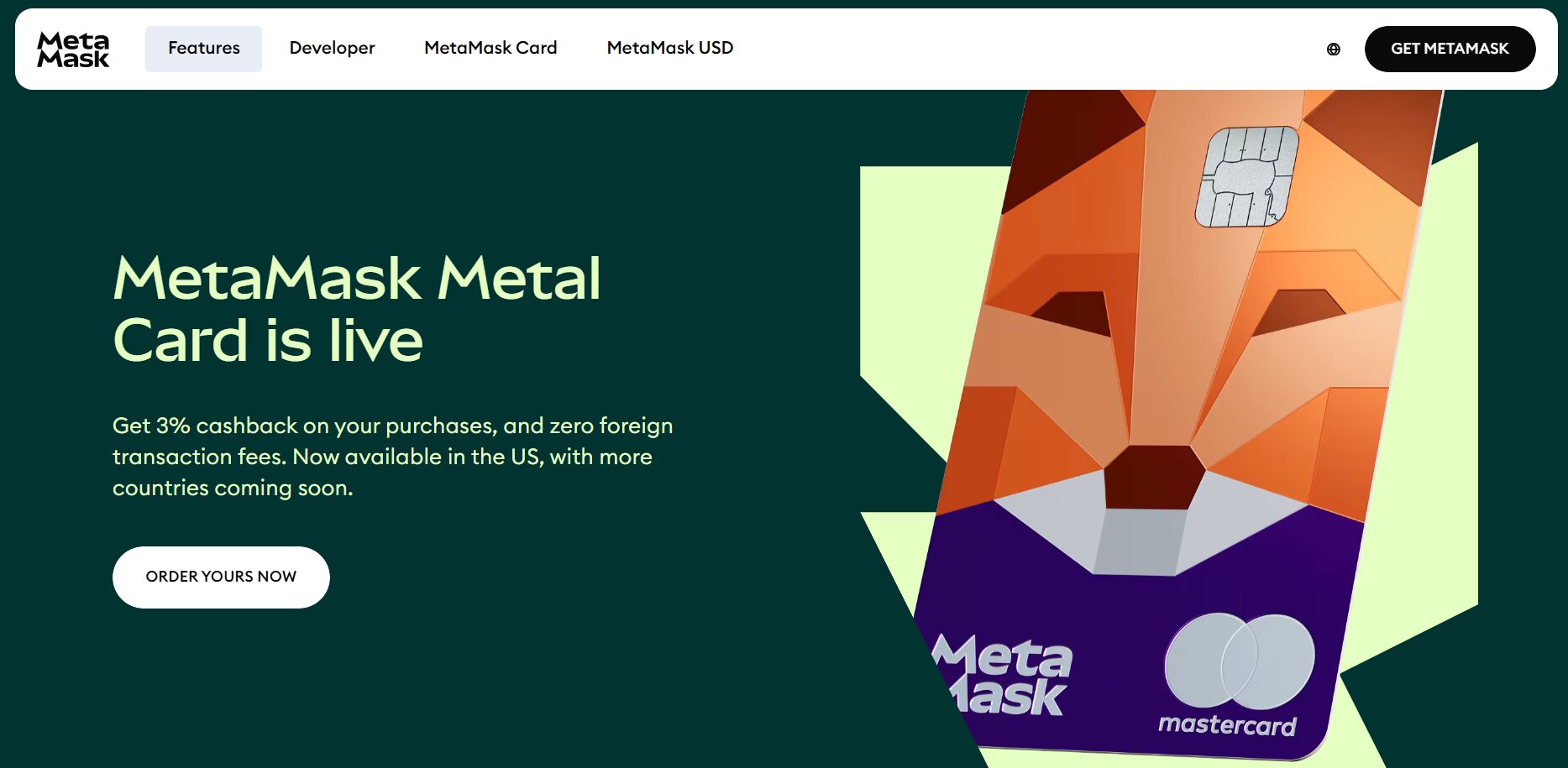
The MetaMask Card is a non-custodial debit card that lets you spend your crypto directly from your self-custody wallet through the Mastercard network. It has officially launched and is currently available, including a widespread rollout in the United States. Well, to be exact, the card is available in 49 US states (excluding Vermont), as well as in the UK, EU, Switzerland, Mexico, Canada, and various regions in Latin America.
You can keep your crypto on either the MetaMask mobile or browser wallet, and when you tap the card at a store, the funds stay in your control until the transaction settles on the “Linea zkEVM network”. Basically, Linea is a zero‑knowledge Layer‑2 on Ethereum. So, transactions get finality quickly while remaining compatible with Ethereum smart contracts.
Rewards and fees: The MetaMask card comes in two versions. The standard virtual card gives 1% cashback on every purchase. But, if you order the premium physical metal card, the cashback literally jumps to 3%. Also, the bonus is capped at $10,000 in annual spend. The cashback is paid in mUSD (MetaMask USD). This is the platform’s newly launched official stablecoin-pegged token. Also, you need to keep in mind that the virtual card has no annual or maintenance fees, while the premium Metal Card costs $199 annually.
2. Crypto.com Visa Card

The Crypto.com Visa Card is a prepaid card that functions on a tiered rewards system where you need to stake their native CRO token to unlock better benefits. Basically, you have to buy and “lock up” CRO in the app to get the best tiers. The card is issued by Bread Financial (Comenity Bank) and uses Visa’s USDC settlement on Ethereum and Solana.
Now, because of USDC settlement across Ethereum and Solana, there is no extra FX fee beyond Visa’s real‑time rate. You still need to pay spreads when you convert crypto to fiat, but there is no hidden markup. The card is available in major regions, including the US, Canada, the EU/UK, Singapore, and parts of Latin America.
Fees and rewards:
| Tier (color) | CRO lock or monthly fee | Cashback |
| Midnight Blue | Free | 1.5% |
| Ruby Steel | $4.99 monthly fee or $500 CRO locked | 3.5% |
| Jade Green / Royal Indigo | $29.99 monthly or $5,000 CRO locked | 4.5% |
| Icy White / Frosted Rose Gold | $50,000 CRO locked | 5% |
| Obsidian | $500,000 CRO locked | 6% |
3. Gemini Credit Card

The Gemini Credit Card is a true credit card that offers category-based rewards paid out directly in crypto with no staking or collateral required. It is issued by WebBank on the Mastercard network. So, it is currently available to people in all 50 U.S. states and Puerto Rico. It is not available outside of the United States. Actually, this is very different from the debit cards we just mentioned. You don’t have to put any money down upfront. It works just like a regular Mastercard from your local bank.
Fees and Rewards breakdown: There are no annual fees and no foreign transaction fees. The card charges a cash advance fee of $10 or 3% if you withdraw cash. Here, you can choose from over 50 cryptocurrencies for your rewards, including BTC, ETH, and SOL.
| Purchase category | Reward rate | Monthly cap |
| Gas, EV charging & public transit | 4% | Capped at $300 in monthly spend, then 1%. |
| Dining (restaurants) | 3% | No special cap beyond your credit limit. |
| Groceries | 2% | No cap |
| Everything else | 1% | No cap |
4. Nexo Card
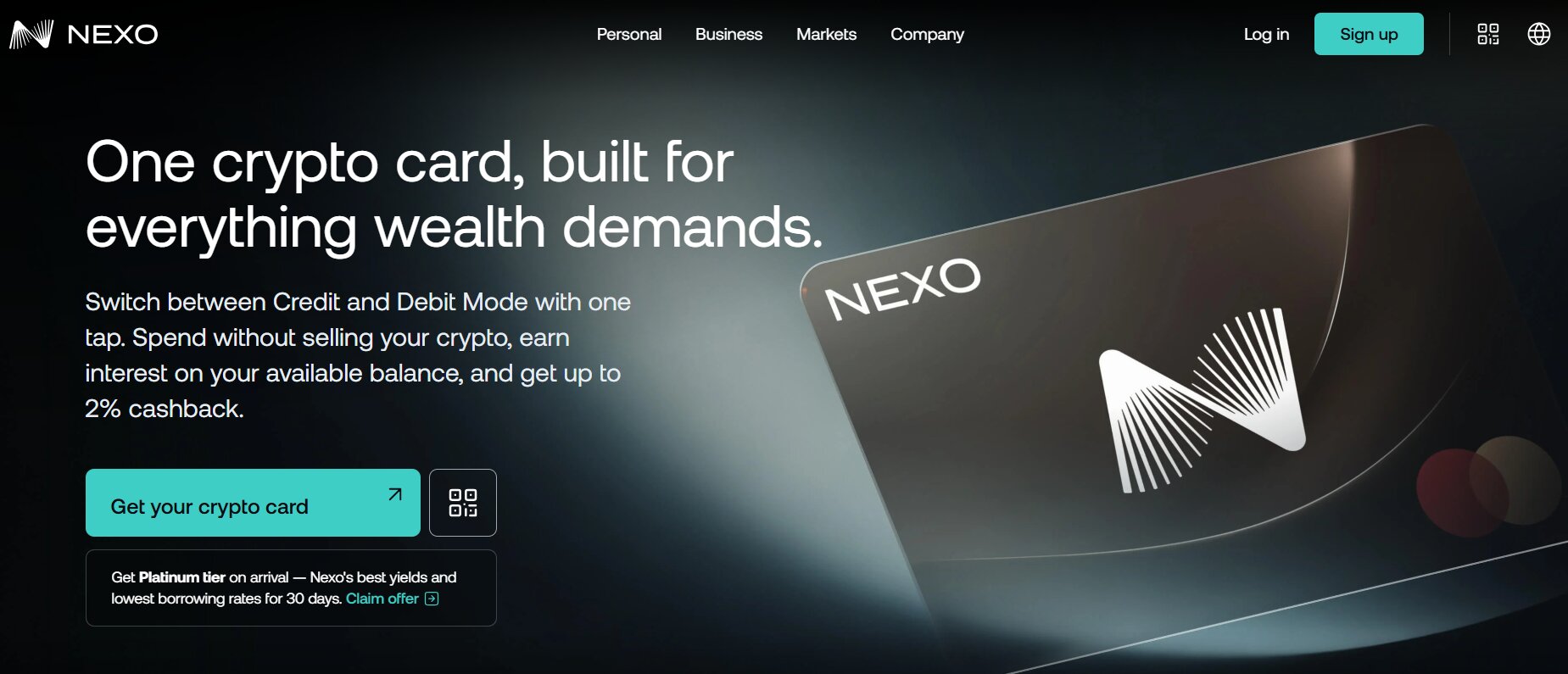
The Nexo Card is a hybrid card that allows you to switch between a “Debit Mode” and a “Credit Mode” within the same physical card. The card is issued by DiPocket and runs on the Mastercard network. Well, the credit mode is the really interesting part. It lets you draw a credit line backed by your crypto collateral rather than selling your assets.
Now, here, the tax savings are huge. You know, you aren’t actually selling your Bitcoin to buy that new laptop, so you effectively avoid an immediate taxable event. You are just borrowing against your coins at rates that can be as low as 0% (depending on tier and LTV ratio). Also, you need to remember that it is currently not available in the U.S. It remains available to selected European countries and the UK only.
Fees and Rewards: The Nexo Card has no annual, monthly, or inactivity fees and offers free virtual/physical card issuance. Here, costs are generally associated with ATM withdrawals (free ATM withdrawals up to €2,000/month, then 2%), foreign exchange (FX) transactions (0.2%+0.5% on weekends), and then blockchain-related spread fees on purchases. Now, about cashback, you can earn up to 2% cashback in NEXO tokens or up to 0.5% in BTC, depending on your tiers. Basically, the higher the Loyalty tier, the higher the crypto reward you will get.
- Platinum: 2% in NEXO Tokens or 0.5% in BTC.
- Gold: 1% in NEXO Tokens or 0.3% in BTC.
- Silver: 0.7% in NEXO Tokens or 0.2% in BTC.
- Base: 0.5% in NEXO Tokens or 0.1% in BTC.
5. Bybit Card
Bybit offers a crypto debit card available in parts of Europe and the Asia-Pacific. It links to your Bybit exchange account and uses the Mastercard network. The card supports a wide range of assets, including BTC, ETH, XRP, USDT, and USDC.
The debit card is available in two main formats: Virtual (for instant online, Apple Pay/Google Pay use) and Physical (for ATM withdrawals and in-store, physical payments). You can get a physical card for a small 5 USDT issuance fee.
Fees and Rewards: Now, exactly like some other top cards, it doesn’t charge any annual fees or monthly maintenance costs. It uses a loyalty points system where you earn points for every 1 Euro or GBP spent. Later, you can then trade these points for trading bonuses or even airdrops. Also, FX fees vary by region (around 0.5% in the EEA and 1% in Australia), and there is a 0.9% crypto conversion fee. Plus, ATM withdrawals are free up to a small monthly allowance (generally $100), then you need to pay 2% fee.
| Tier | Cashback rate | Monthly point / cashback limit | Points per USD spent |
| Tier 1 | 2% | 2,500 points / 5 USDT | 10 |
| Tier 2 | 2% | 25,000 points / 50 USDT | 10 |
| Tier 3 | 4% | 75,000 points / 150 USDT | 20 |
| Tier 4 | 6% | 125,000 points / 250 USDT | 30 |
| Tier 5 | 8% | 200,000 points / 400 USDT | 40 |
| Tier 6 | 10% | 300,000 points / 600 USDT | 50 |
6. Wirex Card

Wirex is another crypto debit card that is available in the UK, EEA, Australia, New Zealand, Hong Kong, and Taiwan. The card uses either the Visa or Mastercard network (depending on your region) and instantly converts crypto and fiat at the point of sale.
It allows you to hold over 50 different crypto and fiat currencies in one app. Their “Cryptoback” rewards program is their big selling point, as you can get up to 8% back on all your in-store purchases, depending on how much WXT you hold. Basically, all your rewards will be paid out in $WXT token. Later, you can convert them into your own token, like BTC.
Fees and rewards tiers:
The Wirex crypto card generally offers a free standard account with no annual fees. Also, card issuance is usually free, but physical card delivery might cost around €5-10, depending on the region. While there are no fees for account maintenance, ATM withdrawals offer a free withdrawal limit of only £200/€200 per month, after which a 2% fee applies. The card has zero foreign transaction fees as well. Next, talking about rewards, you can earn up to 8% cashback.
| Plan | Required WXT stake | Cashback rate | Monthly cap |
| Standard | None | 0.5% | 10,000 WXT |
| Premium | 750,000 WXT locked | 3% | 100,000 WXT |
| Elite | 7.5 million WXT locked | 8% | 250,000 WXT |
7. Bleap Crypto Card

The Bleap Crypto Card focuses on MPC-based non-custodial security, and it is one of the top options for people who hate centralized crypto exchanges. Basically, this card is all about the “Your Keys, Your Coins” philosophy. You don’t need to “deposit” your money into Bleap; you can just connect your smart wallet.
The Bleap smart wallet is deployed on Arbitrum, so all your transactions are settled on the Ethereum Layer 2 network, Arbitrum. The Bleap Crypto Card is primarily available to residents in the European Economic Area (EEA) and the UK. It operates as a Mastercard. Also, you can even integrate this card with Apple Pay or Google Pay for instant spending.
Cashback and Fees: The company offers up to 20% cashback for select subscriptions (Netflix, Spotify, and others), and ordinary purchases earn 2% cashback, paid in USDC. There are no annual fees, no FX markups, and even global ATM withdrawals are free. You can fund the card via bank transfer or by depositing crypto. It supports Bitcoin, Ethereum, Solana, and several stablecoins.
8. Oobit Crypto Card

The Oobit Crypto Card is centered around its “Tap & Pay” NFC functionality, and it allows you to pay merchants worldwide at any Visa terminal. It doesn’t require you to deposit crypto with them. Instead, you need to connect your own crypto wallet through DePay, and when you pay, it draws directly from your wallet and settles to fiat. It supports MetaMask, Trust Wallet, Binance Wallet, or other self-custody wallets.
It lets you spend USDT, Bitcoin, Ethereum, and stablecoins directly. Oobit converts your crypto instantly into local currency at checkout. The Oobit crypto card also has a Bitcoin Card. It lets you pay with Bitcoin online, in-store, on subscriptions, and while traveling.
Fees and Rewards: The Oobit crypto card primarily charges a transaction fee of 1% or $0.25 (whichever is higher) per transaction. Plus, you may also encounter additional costs such as foreign exchange fees of up to 3% for non-USD transactions. Now, it offers 5% cashback for payments using XAUT, USDR, or EURR up to a $200 monthly spend. You can get up to 10% cashback when paying with OOB tokens up to $10,000 per month.
9. Brex Credit Card

The Brex Card is mainly for startups and small businesses. It is a corporate charge card on the Mastercard network. This is probably the best way to manage your team’s spending if you run a startup or a small agency. Actually, the infrastructure is built for scale, so you can issue thousands of virtual cards to your employees with specific spending limits.
Fees and Rewards: There is no annual fee and no foreign transaction fee. Here, limits are quite high; some users report credit lines 10 times higher than traditional business cards. Now, about rewards, you earn points for your spending, and later, you can convert those points to crypto. Brex lets you redeem points for Bitcoin or Ethereum through a partnership with TravelBank and Coinbase. Generally, 1,000 points equal about $7 worth of BTC or ETH.
| Category | Points per dollar | Details |
| Rideshare (Uber, Lyft, taxis) | 7x | Highest multiplier for commuting founders. |
| Travel booked through Brex’s portal | 4x | Includes flights and hotels reserved through Brex. |
| Dining and restaurants | 3x | Earned for meals and entertaining clients. |
| Eligible recurring software | 2x | Subscription SaaS payments, such as Slack and Zoom. |
| Everything else | 1x | Default rate. |
10. Bitget Visa card

The Bitget Card is a custodial Visa debit card linked to your Bitget exchange account. It is mainly available in the Asia-Pacific (APAC) region with additional availability in Europe (EEA/UK) and several Latin American countries. The card offers both virtual and physical options. It can be easily used for online payments where Visa is accepted and supports Apple Pay and Google Pay.
Fees and Rewards: The Bitget Visa Card generally has no annual fees, but charges a 0.90% to 0.95% transaction fee and a 1% foreign exchange fee for non-USD payments. Also, while the virtual card is often free to issue, physical card issuance fees vary by region and card tier. It generally costs around $5-15. It offers a flat cashback rate, and it is paid out in BGB, their native token.
| VIP Level | Card Level | Cashback Rate | Monthly Cashback Cap |
| Non-VIP | 1 | 2% | $5 |
| 1-2 | 2 | 4% | $100 |
| 3-4 | 3 | 6% | $350 |
| 5-7 | 4 | 12% | $800 |
How to Evaluate Crypto Card Attributes?
To evaluate crypto card attributes, you need to consider factors like custody model, settlement network, reward rates and caps, fee structure, and regional availability.
- Custody model: You need to check if the card is non-custodial or custodial before you send any money. Non‑custodial cards like MetaMask, Bleap, and Oobit keep you in control of your keys, whereas custodial cards like Crypto.com, Bybit, and Bitget require deposits into their wallets first.
- Network and settlement: The underlying blockchain network affects the speed and cost of every swipe (in case of non-custodial cards, mainly). Basically, MetaMask uses Linea zkEVM, Oobit uses BNB Chain, and others just depend on the standard Visa/Mastercard rails.
- Rewards vs requirements: You need to compare the reward rates, caps, and lock‑up requirements carefully. A card with 10% cashback may require you to hold $50,000 in tokens (which is obviously not possible for everyone), and also, you should always consider the net reward after you pay the fees. Also, if you are looking for more rewards, you can check out our guide on the best crypto sign-up bonuses.
- Fees: You should check for annual or monthly fees, FX fees, conversion fees, ATM withdrawal charges, and inactivity fees. There are also issuance fees for physical cards.
- Regional availability: You should verify if the card actually ships to your address. You see, cards like Bleap and Nexo exclude U.S. residents right now. So, verify this first.
What are the Best Crypto Debit & Prepaid Cards for Everyday Spending in 2026?
The best crypto debit and prepaid cards for everyday purchases are MetaMask Card, Bleap Crypto Card, and Wirex Card.
- MetaMask Card: It pays up to 3% cashback without requiring a token stake, and uses your existing self‑custody wallet on Linea zkEVM.
- Bleap Crypto Card: This card offers consistent 2% USDC cashback plus up to 20% on select subscriptions. Plus, it’s self‑custodial and has no fees.
- Wirex Card: It provides multi‑currency accounts and free FX. The base 0.5% Cryptoback tier is free, and you can easily upgrade to higher tiers if you lock WXT.
What are the Best True Crypto Credit Cards and Collateral Lines in 2026?
The best true crypto credit cards and collateral lines are the Gemini credit card and the Nexo card.
- Gemini Credit Card: It works more like a traditional credit card, with 4% back on gas and transit, 3% on dining, and 2% on groceries. You can easily pick from over 50 coins to earn crypto rewards
- Nexo Card: This card lets you borrow against your crypto up to €10,000 per day and pays 0.5-2% cashback on spending based on your loyalty tier. Also, you can even switch to debit mode when you have stablecoins on hand.
What are the Best Crypto Cards for Business & Corporate Expenses in 2026?
The best crypto cards for business and corporate expenses are the Brex Credit Card and the Wirex Card.
- Brex Credit Card: It allows you to set up virtual cards for every single department in your company. So, exactly like a regular corporate card, it tracks every receipt, and it syncs with accounting software like QuickBooks.
- Wirex Card: The Wirex card is the best option because Wirex offers a business account for crypto and Web3 companies. It allows you to hold multiple fiat currencies like USD, EUR, and GBP alongside your crypto.

How Do Crypto Cards Work?
Crypto cards work as a bridge by instantly converting cryptocurrency into fiat currency (like USD or EUR) at the point of sale, and allow users to spend crypto anywhere major networks like Visa or Mastercard are accepted. Here’s how it works:
- Authorization: The merchant’s terminal sends a request through Visa or Mastercard. Now, the issuer checks your balance or credit.
- Conversion: Your crypto is converted to fiat instantly for the debit cards part. Non‑custodial cards (like a MetaMask card) require your cryptocurrency wallet to sign a transaction that moves the necessary amount from your crypto balance.
- Settlement: The transaction settles on the underlying blockchain (Ethereum, Solana, BNB Chain, or Linea). Visa or Mastercard then finalizes the payment with the merchant.
- Rewards: Finally, the card issuers deposit your cashback or points either instantly or at the statement cycle.
Do Crypto Cards Report to the IRS?
Yes, crypto cards that are KYC-compliant (Know Your Customer) report transaction data to the IRS. You see, using a crypto card to make purchases involves selling cryptocurrency to pay for goods, which creates a taxable capital gain or loss. The rules in 2026 have become even stricter. The IRS now requires crypto companies to issue 1099-DA forms for digital asset transactions.
However, the reporting is a bit different if you use a non-custodial card like MetaMask or Bleap because there is no central “bank” holding your data. But don’t think you are off the hook because the blockchain is public, and the IRS has very sophisticated tools to track wallet activity. Basically, the best way to handle this is to use a tax software that syncs with your wallet.
The post The 10 Best Crypto Cards for Debit and Credit Spending in 2026 appeared first on CryptoNinjas.
