Solana’s Q1 Report Is Out: What the New Network Data Means for Retail Investors

Solana’s Messari State of Solana Q1 2026 report landed on May 19, and the headline numbers are hard to ignore: roughly 10.1 billion transactions processed in a single quarter, the highest in the network’s history, and real-world assets (RWAs) on the chain crossing $2 billion. On the surface, this looks like a clean growth story.
But quarterly reports can flatter as easily as they inform. The more useful question isn’t whether the numbers are big; it’s whether they signal durable network health or a temporary spike driven by one-off activity. That’s what this breakdown is actually for.
Messari State of Solana Q1 2026 report is now live
TLDR? RWAs up +43% to $2B and Solana now settles nearly half of stablecoin volume across major networks
pic.twitter.com/gYWq9xQH5m
— Solana (@solana) May 20, 2026
DISCOVER: The Next 1000x Crypto Gem Before It Lists on Binance
What Does Solana’s Q1 Data Actually Show?
The Messari report surfaces four metrics worth understanding in plain English, because each one tells you something different, and none of them tells you everything.
Transaction volume: Roughly 10.1 billion transactions in Q1 2026, according to community summaries of Messari’s report. That’s the highest quarterly figure in Solana’s history. What it tells you: the network is being used at scale. What it doesn’t tell you: whether that usage is economically meaningful or dominated by low-value automated activity (bots, arbitrage scripts, spam).
Daily active addresses: Approximately 2.4 million per day on average across the quarter, according to Messari’s data. This matters more than raw transaction count because addresses represent actual participants, wallets doing something intentional, rather than system-generated throughput.
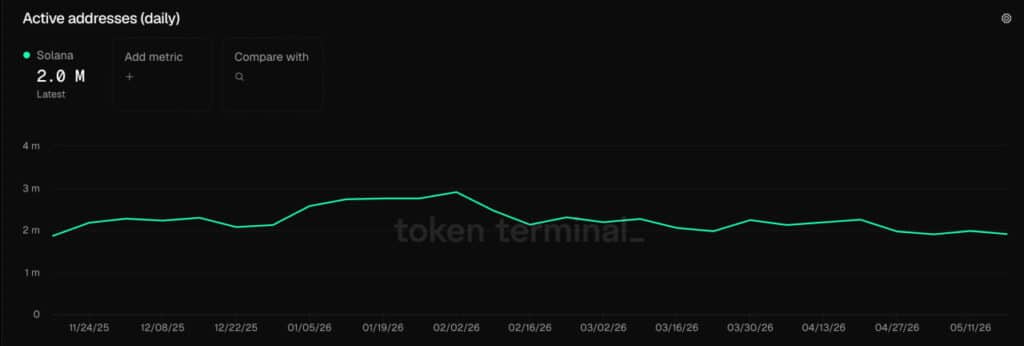
Fee revenue: Network-level revenue came in at around $89.5 million for the quarter, second only to Hyperliquid among all blockchain networks, per Messari’s figures. The single largest app contributor was Pump.fun, generating roughly $124.7 million in Q1 revenues on Solana. That concentration is worth noting, one platform driving a disproportionate share of fees is a dependency, not a diversification.
Stablecoin market cap: Stablecoins on Solana ended Q1 at approximately $14.85 billion, ranking third among all networks by stablecoin capitalization, according to Messari data. Ethereum’s stablecoin base grew only 0.3% that same quarter. Solana outpacing Ethereum’s growth rate here is a meaningful signal for a chain still establishing itself as a serious financial settlement layer.
Taken together, these numbers describe a network that is active, generating real fee revenue, and attracting serious stablecoin liquidity. That’s a different picture from the “ghost chain” narrative that followed Solana’s 2022 outages and FTX collapse.
Is Solana Growing or Just Loud? What the Context Actually Signals
Context matters here. Solana processed 33 billion transactions across all of 2025 and generated nearly $2.4 billion in app revenue that year, according to a detailed technical and economic review published in January 2026. A 10.1 billion transaction quarter in Q1 2026 is consistent with that trajectory, not an anomaly, but a continuation.
The RWA figure, $2 billion on-chain, deserves particular attention. This isn’t retail speculation driving that number. According to a broader market overview of Q1 2026 activity, institutional pilots from BlackRock, Visa, and JPMorgan Chase in stablecoins and tokenized assets contributed to Solana’s RWA growth. Recent RWA expansion activity on Solana reinforces that this is a structural trend, not a single announcement.
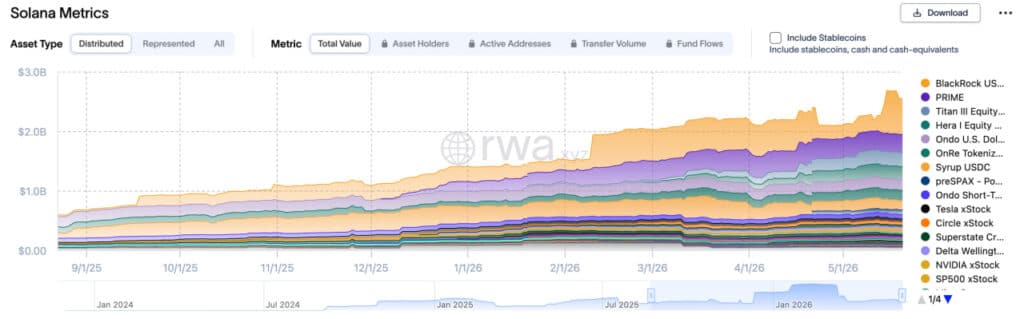
The bullish read: institutional capital validating a chain is a slow but durable signal. Once compliance infrastructure and settlement workflows are built on a network, they don’t move easily. The bearish read: $2 billion in RWA is still a small fraction of the traditional asset market, and institutional pilots can be paused or redirected. Early traction is not guaranteed adoption.
Firedancer, Jump Crypto’s independent validator client that went live on mainnet in January 2026, is also part of this story. Cutting block finality below 150 milliseconds matters for institutional use cases that require near-real-time settlement. Ongoing Solana network upgrades signal that the developer infrastructure supporting these metrics continues to improve.
EXPLORE: Best Crypto Presales to Watch in 2026
Follow 99Bitcoins on X, YouTube, and Telegram for more crypto news and analysis.
The post Solana’s Q1 Report Is Out: What the New Network Data Means for Retail Investors appeared first on 99Bitcoins.
